How to Record, Mix, and Upload Cover Songs: A Complete Beginner's Guide (Free)
What Every Beginner Should Know Before Recording a Cover Song
"I want to sing my favorite song and post it on YouTube or social media" — if that sounds like you, you're probably stuck on two questions: "How do I actually record it?" and "Am I allowed to post it legally?" This guide walks you through the entire process — recording, mixing, and uploading a cover song — step by step, using free tools that run entirely in your browser, no software installation required.
By the end of this article, you'll know how to produce a polished cover song and publish it online without installing a single app.

The Big Picture: 5 Steps to a Finished Cover Song
The process of completing a cover song breaks down into five key stages. Let's get familiar with the full picture before diving in.
- Get an instrumental backing track
- Set up your microphone and DAW (recording environment)
- Record your vocals
- Mix your track (balance levels and apply effects)
- Clear copyright and upload your cover
Let's go through each step one by one.
Step 1: Get an Instrumental Backing Track
To record a cover, you'll need an instrumental version of the song — a backing track with no lead vocals. Here are three ways to get one.
Option A: Use an Official Karaoke or Instrumental Service
Platforms like Karaoke Version, Sing King, or official releases on streaming services often offer licensed instrumental tracks. These are the safest option since the rights have already been cleared by the rights holders.
Option B: Remove the Vocals with an AI Vocal Remover
You can strip the vocals from any song using an AI-powered tool. LA Studio's AI Vocal Remover runs entirely in your browser and can separate vocals from a track in just a few minutes. Powered by WebGPU technology, it's significantly faster than traditional server-based tools and preserves audio quality remarkably well.
Option C: Use an Official Off-Vocal Version Released by the Artist
Some artists and labels release official instrumental or karaoke versions of their songs on YouTube or streaming platforms. Always check the terms of use before downloading or using these files.
Step 2: Set Up Your Recording Environment
Setting up your home studio doesn't have to be complicated. Here's what you actually need to get started.
Essential Gear
- Microphone: Your smartphone's built-in mic will technically work, but a USB condenser microphone (such as the Audio-Technica AT2020USB+ or Blue Yeti, typically $50–$150) will make a dramatic difference in audio quality.
- Headphones or earbuds: Essential for monitoring while you record. If you record with speakers on, the audio will bleed into the microphone and cause feedback.
- A quiet room: Minimize background noise from air conditioning, traffic, or appliances. Hanging blankets or duvets around your recording space can significantly reduce echo and room reverb.
Skip the Installation — Use a Browser-Based DAW
Traditional DAWs like Audacity, GarageBand, or Pro Tools are feature-rich but can take hours to install and configure. LA Studio, a browser-based DAW, requires zero sign-up or installation — just open the URL and start recording. It works on PC, Mac, and Chromebook.
Step 3: Record Your Vocals
Once your setup is ready, it's time to record. Here's how to do it using a browser DAW like LA Studio.
Step-by-Step Recording with LA Studio
- Open https://la-studio.cc/editor in your browser (Chrome recommended)
- Create a new project and drag and drop your backing track (MP3, WAV, etc.) into the timeline
- Add a new audio track, connect your microphone, and grant browser microphone permissions when prompted
- Put on your headphones, listen to the backing track, and click the record button (●) to start singing
- When you're done, save and export your recording (WAV recommended for quality)
3 Tips for Better Vocal Recordings
- Record multiple takes: Don't try to nail it in one shot. Record 3–5 takes and piece together the best parts — a technique called comping.
- Stay 6–8 inches from the mic: Getting too close causes the proximity effect, which makes your voice sound overly boomy and bass-heavy.
- Use a pop filter: Plosive sounds like "p" and "b" can cause loud thumping in your recording. A pop filter (or even a thin sock stretched over a wire hanger) prevents this.
Step 4: Mix Your Cover Song
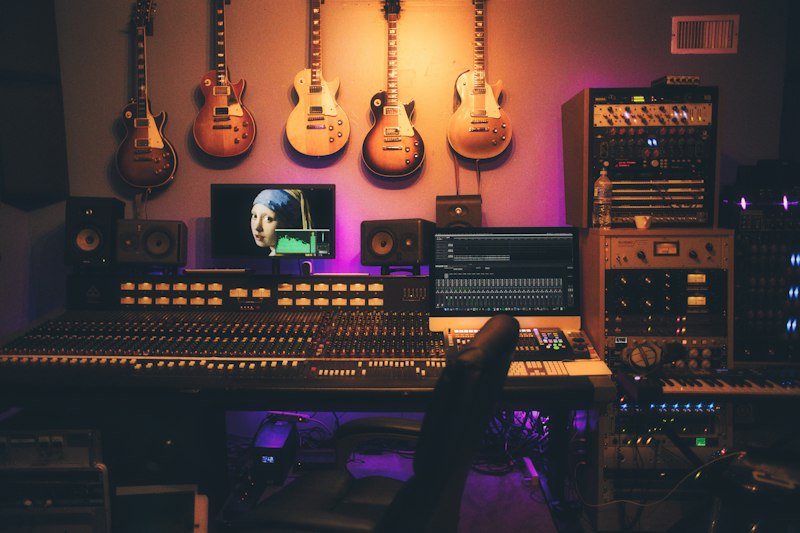
Once recording is done, it's time to mix — blending your vocal with the backing track so everything sounds cohesive. Mixing involves adjusting levels, cleaning up the audio, and adding effects to make the vocals sit naturally in the music.
5 Essential Mix Processes for Cover Songs
① Noise Reduction
Remove background noise like hiss or air conditioning hum that crept in during recording. LA Studio's AI Noise Removal tool can automatically detect and eliminate unwanted noise with a single click.
② Pitch Correction (Auto-Tune)
Fix slight pitch inconsistencies in your performance. LA Studio's pitch correction tool offers a Melodyne-style visual interface where you can edit individual notes intuitively. GarageBand's Flex Pitch works similarly for Mac users.
③ EQ (Equalization)
Use a high-pass filter to cut frequencies below 200Hz, cleaning up muddiness from your vocal. Boosting slightly in the 2–5kHz range adds presence and clarity, helping your voice cut through the mix.
④ Compression
A compressor evens out the dynamic range between your loudest and softest notes. Start with a ratio of 3:1 to 5:1 and an attack time around 10ms as a baseline.
⑤ Reverb and Delay
Add a sense of space and depth to your vocals. Start with a Small Room or Hall preset and set the wet (effect) level to around 20–30%. Going too heavy on reverb will cause your vocals to get lost in the mix.
Comparing Free Mix Tools
- LA Studio (browser-based): Includes 20+ built-in effects — reverb, delay, compression, EQ, and more. Handles noise removal and pitch correction all in one place, no installation needed.
- Audacity (PC/Mac): A veteran free DAW with plenty of features, but the interface can feel clunky for beginners and some functionality requires additional plugins.
- GarageBand (Mac/iOS only): Intuitive and beginner-friendly with a polished UI. Free, but Apple-exclusive.
- Cakewalk by BandLab (Windows only): A fully professional DAW available for free, but Windows-only and requires installation.
Step 5: Handle Copyright and Upload Your Cover
Copyright is the most important thing to get right before you post. Singing a cover song privately is fine, but publishing it on YouTube or social media requires addressing copyright.
Copyright Basics for Cover Songs
In most countries, the underlying musical composition (melody and lyrics) is protected by copyright and managed by performing rights organizations (PROs) such as ASCAP, BMI, or SESAC in the US, or PRS for Music in the UK. Posting a cover online requires a license to reproduce and distribute the composition.
Copyright Considerations by Platform
YouTube
YouTube has licensing agreements with major PROs worldwide, which means you can generally upload cover songs without filing a separate application. However, YouTube's Content ID system may flag your video, restrict monetization, or place ads on your video with revenue going to the rights holders instead of you.
TikTok and Instagram
Both platforms have licensing deals with major rights organizations, so cover song posts are generally permitted. However, restrictions may apply depending on video length and usage context.
Important: Master Recording Rights (Neighboring Rights)
Apart from the composition copyright, the actual sound recording (the master) is protected separately. Using a commercially released recording as your backing track — even a karaoke version — may infringe on the master rights held by the record label. To stay safe, use a self-produced instrumental, an AI-separated backing track, or an officially licensed karaoke track.
How to Check If a Song Is Registered with a PRO
In the US, you can search ASCAP's ACE Repertory or BMI's Repertoire Search to check whether a song is registered and who manages the rights.

Advanced Tips to Take Your Cover to the Next Level
Use Stem Separation to Study the Arrangement
Want to isolate the drum groove or learn the bass line of a song? LA Studio's AI Stem Separator can split a track into up to 6 stems — vocals, drums, bass, and more. It's a great tool for ear training and for dialing in the right feel when you're producing your own backing tracks.
Check the BPM and Key Before You Start
Knowing the tempo and key in advance lets you transpose the song to a more comfortable range or lock in your recording grid. Upload your audio to the BPM and Key Detector for an instant automatic analysis.
Optimize Your Title and Thumbnail
To get more views after uploading, include the song name and keywords like "cover" or "vocal cover" in your title. For thumbnails, a clear photo of yourself or a lyric snippet displayed prominently tends to attract more clicks.
Frequently Asked Questions
Q. Can I record and upload a cover using just my smartphone?
A. Yes, absolutely. Your phone's built-in microphone is enough to get started, and LA Studio runs on Chrome for Android and iOS. For noticeably better audio quality, consider a plug-in condenser microphone for your phone — they're available for around $20–$50.
Q. Can I freely post covers of public domain or Creative Commons songs?
A. Songs whose copyright has expired (typically 70+ years after the composer's death) or songs released under a Creative Commons license that permits commercial use are generally free to cover and publish. Just make sure to verify the status of the specific recording, not just the composition — master rights may still apply.
Q. What if mixing feels too overwhelming to do myself?
A. You can hire a mixing engineer through platforms like Fiverr or SoundBetter. Rates typically range from $30 to $150 per song depending on experience. Alternatively, browser-based tools like LA Studio offer AI-powered automatic processing (noise removal, pitch correction) that makes it much more approachable for beginners.
Q. Can I monetize a cover song on YouTube?
A. In most cases, Content ID will claim your video on behalf of the original rights holders, directing any ad revenue to them rather than you. If monetization is your goal, you'll need to obtain a separate license directly from the rights holders, or focus on covering public domain or Creative Commons songs.
Q. Why does my voice sound out of place — like it doesn't belong in the track?
A. The three most common culprits are: ① your reverb doesn't match the space of the backing track, ② your vocal level is too high in the mix, and ③ you haven't EQ'd out the frequencies where your voice clashes with the instruments. Try adding a light reverb that matches the feel of the track, pull the vocal volume back slightly, and use EQ to cut a little in the 400–600Hz range to reduce muddiness. These three adjustments alone can make a huge difference.
Wrap-Up: You Can Start Recording a Cover Song Right Now — In Your Browser
Recording, mixing, and uploading a cover song is completely achievable for beginners when you have the right workflow and free tools. Here's a quick recap:
- Get your backing track via AI vocal removal or an official karaoke service
- Record with a USB condenser mic, headphones, and a quiet room
- A browser-based DAW like LA Studio lets you record and mix without installing anything
- Mix in this order: noise removal → EQ → compression → reverb
- Posting covers on YouTube is generally covered by PRO licensing agreements
The best way to start is to open LA Studio in your browser right now and record your first take. Don't overthink it — finishing a song, even an imperfect one, is the fastest way to improve.